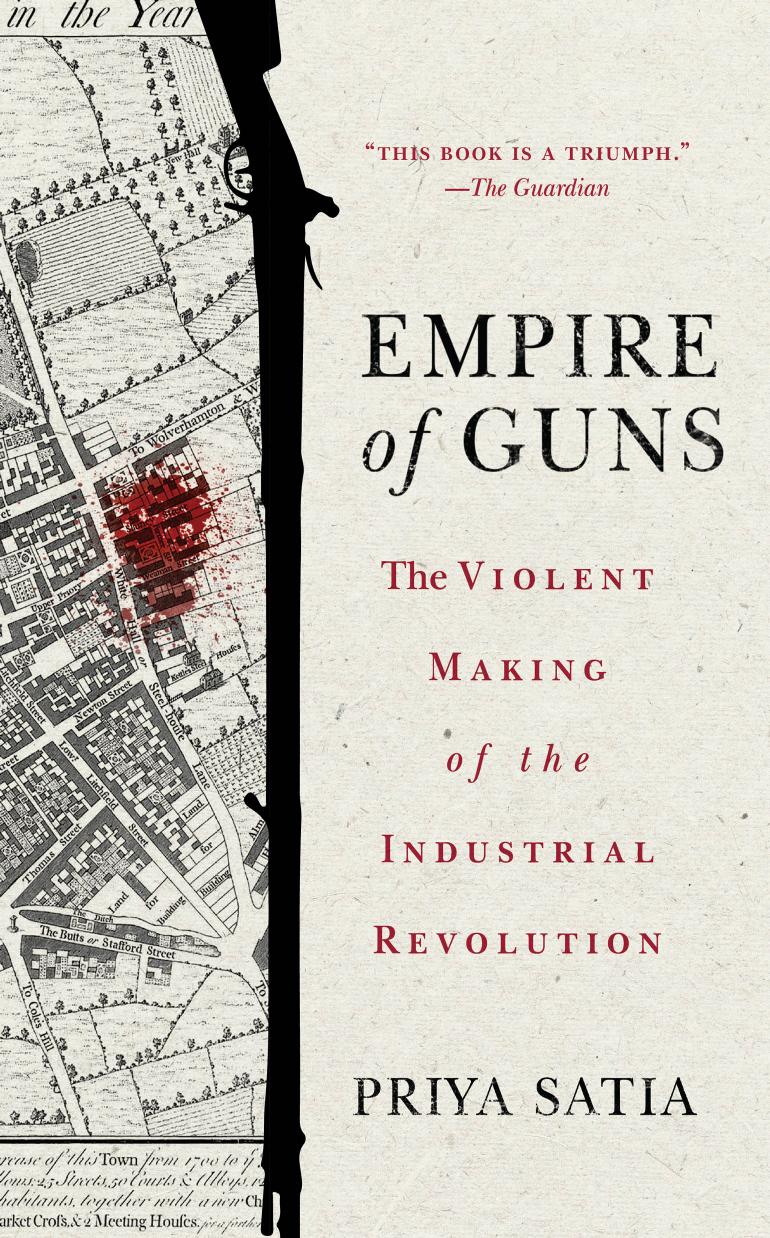
Empire of Guns by Priya Satia
Author:Priya Satia
Language: eng
Format: epub, pdf
Publisher: Penguin Publishing Group
Published: 2018-04-10T04:00:00+00:00
8
Galton’s Disownment
By the 1790s, the Society of Friends was in earnest about the Galton family business, but the pressures shaping that new agenda did not necessarily resonate with its members. The elder Galton fell in line, but his quick passing of the business to his son suggests that he hardly felt doing so would implicate his son’s soul; there was nothing newly damning about the business in his eyes. The son’s defense also made much of his innocent inheritance of the business, leaving the question of original sin unanswered. His father’s action smacks of expedience, perhaps expected from this eternal worrier, who must have borne the Society’s admonitions with a great deal of anxiety. His son was made of stiffer stuff and determined to engage in an analytical contest with his judges.
Some of his self-assertion, bordering on arrogance, stemmed from his consciousness of his cultural stature as a scientist and fellow of the Royal Society—as a practitioner of Enlightenment civility. His pose in engaging with the Society’s complaints was self-consciously analytical and modern. The distinction was temperamental, too. Galton Jr. had long experience in defending himself and his principles in public squabbles since his youthful clash with Thomas Hadley. He mediated a dispute over management of the town’s poor in 1790. During the riots of 1791, when the Priestleys fled their home ahead of a torch-wielding mob, Galton offered them shelter, courting danger himself. Later, he pressed Priestley for news of his return from London, promising to meet him and show his attachment to him publicly. He asked Priestley to come to the next Lunar meeting, which he would be hosting; Boulton, by contrast, did not attend when he heard that Priestley might be there. (In the end, Priestley was not.) Once, finding a doctor courting one of his daughters in his carriage drive, Galton asked whether he had come to see one of the servants, a calculated gesture of snobbery. From the bankruptcy of the 1750s through the battle with Hadley and the heroism of 1791, moral indignation and the sense of being unjustly persecuted had become a genuine Galton trait.
This was the formidable creature the Birmingham Meeting contended with in 1795. The minute relating to his case was continued month to month. Then, in January 1796, he sent the meeting a letter—his defense. Acknowledging the “candid and liberal conduct” of his worthy friends (Lloyd, Baker, and Gibbins) who had vilified him on the meeting’s behalf, he sought to answer the accusation, disrupt the process of disownment, and clear the smudge on his character. He requested that the meeting preserve his letter in their records. It was printed for ease of circulation, but also preservation. Though it was addressed to the meeting, he intended it also as a legacy for his “children or others who may feel an interest in the event.” He was concerned with posterity’s judgment and confident of the substance of his argument. This is an essential point. To the extent that rationalization was at work,
Download
This site does not store any files on its server. We only index and link to content provided by other sites. Please contact the content providers to delete copyright contents if any and email us, we'll remove relevant links or contents immediately.
| Africa | Americas |
| Arctic & Antarctica | Asia |
| Australia & Oceania | Europe |
| Middle East | Russia |
| United States | World |
| Ancient Civilizations | Military |
| Historical Study & Educational Resources |
Room 212 by Kate Stewart(5130)
The Crown by Robert Lacey(4820)
Endurance: Shackleton's Incredible Voyage by Alfred Lansing(4788)
The Iron Duke by The Iron Duke(4367)
The Rape of Nanking by Iris Chang(4224)
Joan of Arc by Mary Gordon(4117)
Killing England by Bill O'Reilly(4008)
Say Nothing by Patrick Radden Keefe(3991)
I'll Give You the Sun by Jandy Nelson(3451)
Shadow of Night by Deborah Harkness(3377)
Hitler's Monsters by Eric Kurlander(3348)
Mary, Queen of Scots, and the Murder of Lord Darnley by Alison Weir(3215)
Blood and Sand by Alex Von Tunzelmann(3207)
Eleanor & Park by Rainbow Rowell(3185)
Darkest Hour by Anthony McCarten(3135)
Margaret Thatcher: The Autobiography by Thatcher Margaret(3087)
Book of Life by Deborah Harkness(2943)
Red Famine: Stalin's War on Ukraine by Anne Applebaum(2940)
The One Memory of Flora Banks by Emily Barr(2870)
